MAKER DAD: Making at the Right Price
Maker Dad, Dave Lewis, sizes up his MakerSpace for would-be facilitators.
By David Lewis
March 18, 2013
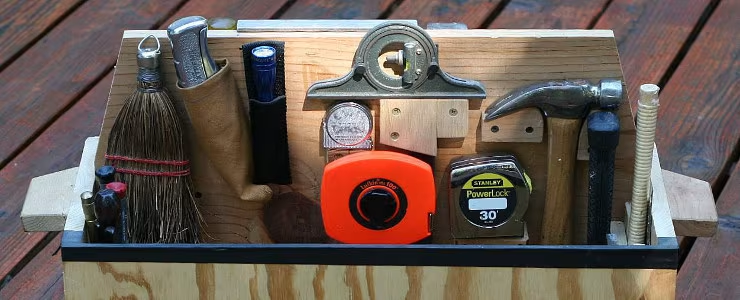
Flickr: veryuseful
Having been in the same house for more than 15 years now, we’ve acquired many tools. I once bought a portable band saw because Adam Savage had one and the price was right on e-Bay. In addition to the portable band saw (which REALLY is useful) my tool list is significant and includes:
Table Saw, Circular Saw, SawzAll, Miter Saw
Free standing Drill Press
Corded & Cordless drills
Grinder
Workbench with vises
Hammers, Mallets & Drivers
100Kg Anvil, a forge & tools
Power Planer
Biscuit Joiner
Bench top belt & disc sander
Belt sander
4” grinder
Eight drawer rolling tool chest
15 Gallon Compressor
Do I really “need” all these tools? Probably not, but it makes things easier when I have the best tool for the job and get the work done quickly and precisely.
The question I get from other parents is: “What basic tools do we really need?” The answer depends on how deep you get into being a Maker. In the early process of “making” things you need to be able to:
Precisely cut wood, plastic, paper, fabric & other light materials
Attach or “join” those items you have previously cut
Reshape an object
Take an existing item apart to reuse or repurpose components
Here are my recommendations for tool kits ranging from the bare essentials to advanced components depending on your budget and the making experience you want to facilitate.
Basic Tool Kit (for about $50)
Note: as you start out, Harbor Freight and the local Dollar Store are great places to source your tools. If you use them enough to wear them out, buy a better one the next time. Yard sales are also a great place to look for non-powered tools.
Here is the Basic List:
Hot melt glue gun ($2-3)
A multi-part “bit and driver” set from Costco or Orchard Supply Hardware. This is NOT the drill bit set, but rather the set with Torx, Hex, Square, Flathead, Phillips and other “bits’ and a handle to turn them ($9-15)
Utility knife ($1-3)
Multipurpose wood saw ($7-10)
Hacksaw ($1-5)
Claw Hammer ($3-5)
Needle Nose Pliers ($1-5)
Crescent wrench ($1-4)
Side Cutter pliers ($1-4)
Wood Glue ($2-3)
Superglue ($2-4)
Screw assortment ($5)
Nails ($2-5)
Measuring tape (free at harbor Freight--watch for the coupon)
In this kit the multi-bit set may be the most valuable, especially if you are going to take items apart and reuse components.
The next level involves adding some power tools, but keep in mind that while the upscale 18-24 volt battery pack tools are shop sexy, they are a lot more expensive than the corded ones and will require replacing the battery packs at some point.
Intermediate Kit $100-125
Basic Kit plus:
NEWSLETTERS
STAY AHEAD IN EDUCATION.
Sign up for EdSurge newsletters for timely news, insights and analysis.
Corded 3/8th drill (Harbor Freight $16 with Coupon)
2 saw horses & a 3’x’4 piece of ¾ particle board as a dedicated work surface ($25)
Drill index (Harbor Freight $10 with Coupon)
Assorted sandpaper packs ($5-10)
Basic 3/8th socket set ($20)
At this point you will have the tools to make almost anything from a bird house to a plastic housing for a custom built computer. Now let’s look at the upper end of the things we have found valuable.
Rounding Out Your MakerSpace
There is no definitive guide book to making, but if there were the fine print would read: "To quickly add value to your MakerSpace, create infrastructure." Here are a few items which really add value by addressing space and equipment bottlenecks that naturally arise in a MakerSpace.
Jawhorse from Rockwell. Expensive at $160 but hugely versatile
Ketter folding workbench with clamps. $50 at Costco and worth every penny
Dremel tool $(30-120) plus accessories
Free Standing Drill Press (free, but I had to haul it home)
Portable Milwaukee band saw
Bench grinder ($35 at Harbor Freight)
File set ($6 at harbor Freight)
Wood Chisel set ($5 at Harbor Freight)
A multi-drawer, pre-stocked hardware assortment! ($20-80)
The last item on this list is the one we go to the most often. We have a 4-drawer Olympia with trays of:
English nuts, bolts, washers
Metric nuts, bolts, washers
Wood and metal screws in different sized and head shapes
Electrical connectors, roll pins, cotter pins, circlips, o-rings
Often in the course of a project, when we need a specific size part, it is there in the kit. No trip to Home Depot. We figure that over time that this kit has saved hundreds of trips and let us finish projects much faster, which is important with kids around.
This is not the complete list of tools in our shop (some of which I haven’t seen in months) but hopefully you have a practical understanding of what it takes to start a MakerSpace. Of course, these kits aren't the only approach. There are low-tech solutions which place more emphasis on making with arts and crafts (à la design-thinking) and high-tech solutions involving CNC machines, 3D printers, and laser cutters. Not to mention a ton of robotics-oriented materials like the low-cost Arduino boards. If we've left anything off the list that you've found valuable in your MakerSpace, don't hesitate to reach out or leave a comment!
Popular on EdSurge
News
Hundreds of Thousands of Eligible Kids Are Waiting for Childcare Assistance
Moriah Balingit and Lauren CoffeyNews
A Principal and a Student Reviewed the New ChatGPT for Teens. They Had Plenty to Say
David WeldonRead Next

Voices of Change
Artificial Intelligence
Why AI Made Me a Better Principal


Voices of Change
Artificial Intelligence
Protecting Student Cognition in the Age of AI

Voices of Change
Artificial Intelligence

News
EdSurge Podcast
Assignments, Invoices, and the AI Fix

Voices of Change
Artificial Intelligence