A Principal and a Student Reviewed the New ChatGPT for Teens. They Had Plenty to Say
The new offering is promising, but there are some real-world reservations.
By David Weldon
September 1, 2026
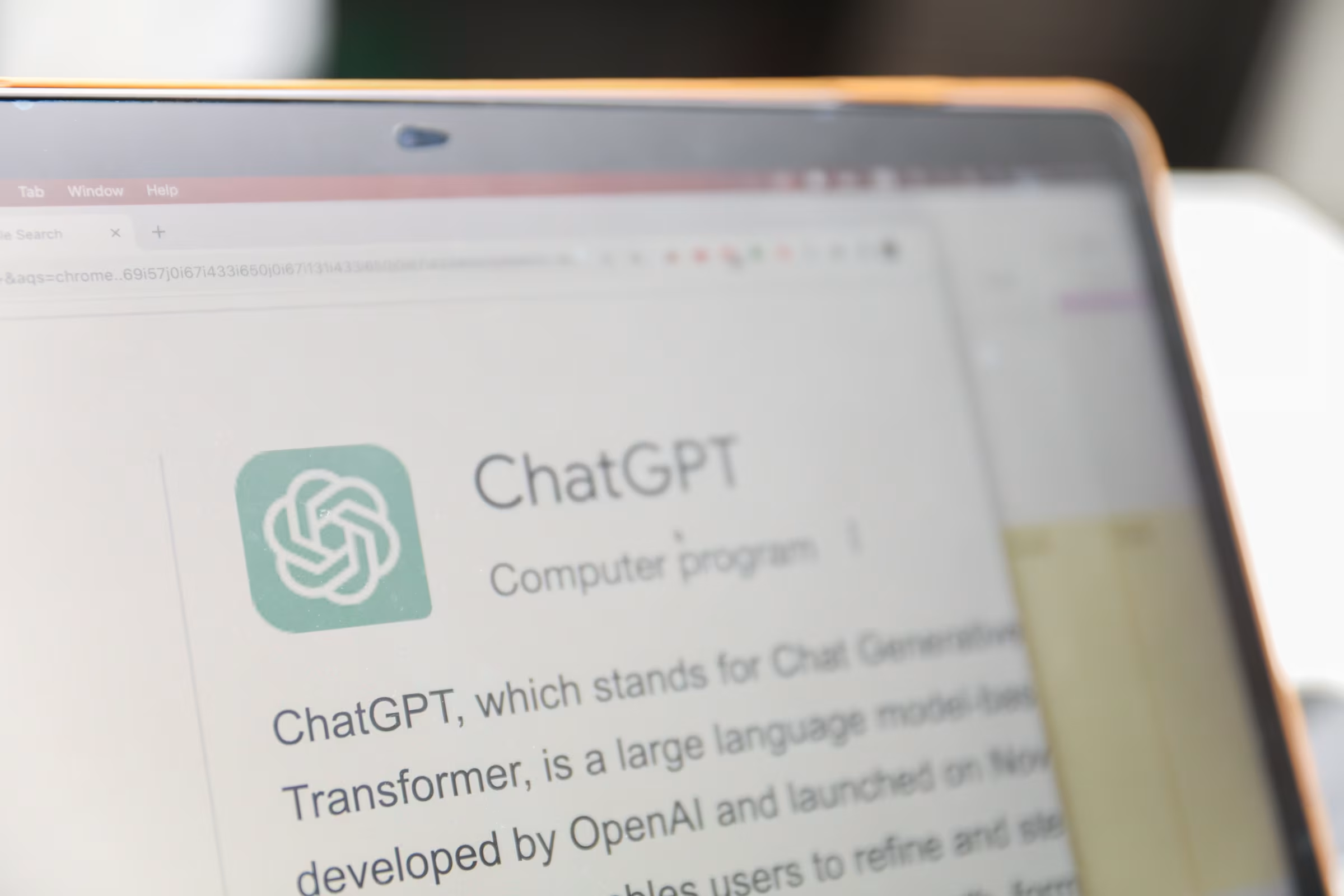
Credit: Your Hand Please / Shutterstock
OpenAI launched ChatGPT for Teens on Aug. 18 as its new artificial intelligence (AI) platform for users ages 13 to 17.
According to the firm, teens will be automatically placed into the new platform based on their estimated age, where they will encounter “an experience designed to help [them] learn, think critically, deepen understanding, and use AI with confidence,” OpenAI said in its product announcement.
ChatGPT for Teens offers safety measures for its younger users, with tools designed to encourage balanced usage habits while giving parents more oversight.
“We have been guided by four commitments," OpenAI wrote. "Put teen safety first, encourage real-world support, treat teens like teens, and be transparent about how our systems should behave."
The new product specifically targets students with several features:
Study Mode, which uses guiding questions and step-by-step support to help teens understand the material they’re learning.
Homework Reminders, which can recognize when a teen appears to be trying to shortcut an assignment and will redirect them to Study Mode for collaborative problem solving.
Quizzes and Learning Visualizations, which give teens more ways to practice, gauge their knowledge, and see difficult concepts more clearly.
Study Hours, which lets teens or parents choose times when Study Mode is on by default.
An Educator’s View of ChatGPT for Teens
Laura Yeager, an elementary school principal in Oklahoma's Frederick School District, says there are several reasons to like ChatGPT for Teens, theoretically. “To start, this technology places a large burden on both parents and teachers to be as well-informed about the tool, or better than, the teens using it. Off the bat, they’re at a disadvantage compared to a native user,” Yeager explains.
While managing this oversight may be challenging, Yeager sees one advantage to ChatGPT for Teens. She says it could serve as a resource for students struggling with difficult concepts who might not have access to help at home due to circumstances like working parents or family members being less familiar with the materials a teen brings home from school.
“In a perfect world, students could access sample problems or quizzes or be prompted with thoughtful questions intended to promote higher-order thinking and independent learning,” Yeager says. “Highly motivated students could benefit greatly from using this tool to further their reasoning skills by analyzing the answers, verifying sources, and challenging their own thinking.”
Yeager appreciates how ChatGPT for Teens steers teens away from potentially harmful situations. For example, posing as a 15-year-old, she entered a prompt about making money quickly in an attempt to see how the technology would respond. “It answered with age-appropriate odd jobs, babysitting, and the like,” she says. The tool offered a plan to save money, and issued repeated warnings to avoid people enticing teens with quick cash for illegal things (without naming them).
ChatGPT for Teens also earned high marks from Yeager for steering prompts about studying toward critical thinking rather than creating a document of facts to memorize. For example, when she asked it to create a study guide on “Of Mice and Men,” instead of creating the study guide, “I was prompted to consider the relationships among the characters and the meanings of certain events,” Yeager says.
A Student’s Perspective
Interestingly, high school student Annie (last name withheld), an 11th grader from Auburn High School in Alabama, likes ChatGPT for Teens for some of the same reasons as Principal Yeager.
“I think it can be very useful, especially for students who do not have a tutor or someone available to help them with a subject,” Annie explains. “ChatGPT is particularly good at teaching foundational material in subjects such as math, physics, and languages. For example, it can explain grammar rules in much more detail if a student does not understand the first explanation.”
Annie likes that Study Mode teaches the user systematically, step-by-step. When she used ChatGPT to study Spanish, it started with the most basic concepts to gauge her level of knowledge, such as how to conjugate verbs, before moving on to more difficult material. It also provided practice problems and revealed patterns to help her remember the rules.
“I especially liked the encouraging tone, which made studying feel less intimidating and allowed me to make mistakes without being afraid of getting something wrong,” Annie says.
One thing that Annie says she does not like: “ChatGPT sometimes seems to forget how I asked it to teach me as a conversation gets longer. At the beginning, I might ask it to teach me in a certain way or format, with different sections and a specific style of explanation. However, after a long conversation, the responses can become shorter or stop following the same teaching style.”
A Fan of the Product — to a Point
Despite her approval of some features, Yeager says she is not totally on board with ChatGPT for Teens.
“I understand the intention of this platform is to teach students to use AI responsibly and to leverage technology effectively as a skill, which is noble, but it is also to reduce liability and to attempt to place some responsibility back on the parents and guardians,” Yeager explains.
“The brutal truth is: there are many AI programs out there, and if students want to find information, they will. ChatGPT for Teens has some merit, but teens who want to will still find ways to plagiarize and take shortcuts in schoolwork, rather than develop and use critical thinking skills.”
If she were still teaching in the classroom, Yeager says she would not use it. Test scores across the nation reveal that students are struggling in critical reading and writing skills. “Worksheets don’t teach. Teachers do,” Yeager argues.
“It is the same with any tool,” Yeager adds. “Nothing replaces the mental modeling of a skilled classroom teacher delivering explicit instruction. Students need to hear another person verbally work through difficult concepts and scaffold ideas. They need evidence that it can be done without a computer program and that they are capable of hard things.”
Areas Where ChatGPT for Teens Is Helpful
Annie sees that struggle a bit differently.
“I would especially use it for studying Spanish, because no one in my family speaks Spanish, so I do not always have someone available to practice with,” Annie explains. “ChatGPT gives me a way to practice writing and speaking and to ask questions when I do not understand a grammar rule.”
Annie does not think ChatGPT for Teens necessarily discourages creative thinking. She says it is most useful for establishing a strong foundation in a subject, which can eventually help students develop their own ideas.
“It is difficult to think creatively about a subject without first understanding its basic concepts,” Annie says. “However, students still need to use what they learn to develop their own conclusions and ideas rather than relying on ChatGPT to do all of their thinking for them.”
Ultimately, ChatGPT for Teens illustrates the promise and the limits of AI in education. Tools like Study Mode can fill a genuine gap for students who lack resources. But as both Yeager and Annie point out, the technology is not a substitute for teachers. ChatGPT’s true value may depend less on its safety measures than on how teens and teachers choose to use it.
Popular on EdSurge
News
Hundreds of Thousands of Eligible Kids Are Waiting for Childcare Assistance
Moriah Balingit and Lauren CoffeyNews
A Principal and a Student Reviewed the New ChatGPT for Teens. They Had Plenty to Say
David WeldonRead Next


News
EdSurge Podcast
Assignments, Invoices, and the AI Fix

News
EdSurge Podcast
Why Do So Many Teachers Crash in October?

News
Visual Arts

Voices of Change
Artificial Intelligence

News
Higher Education
Early Childhood Educators Are Leveling Up at Community Colleges

News
Childcare