AI Meets ESL, and Teachers Are Intrigued
Can AI chatbots support K-12 emergent bilingual learners without widening gaps?
By Adam Stone
July 16, 2026
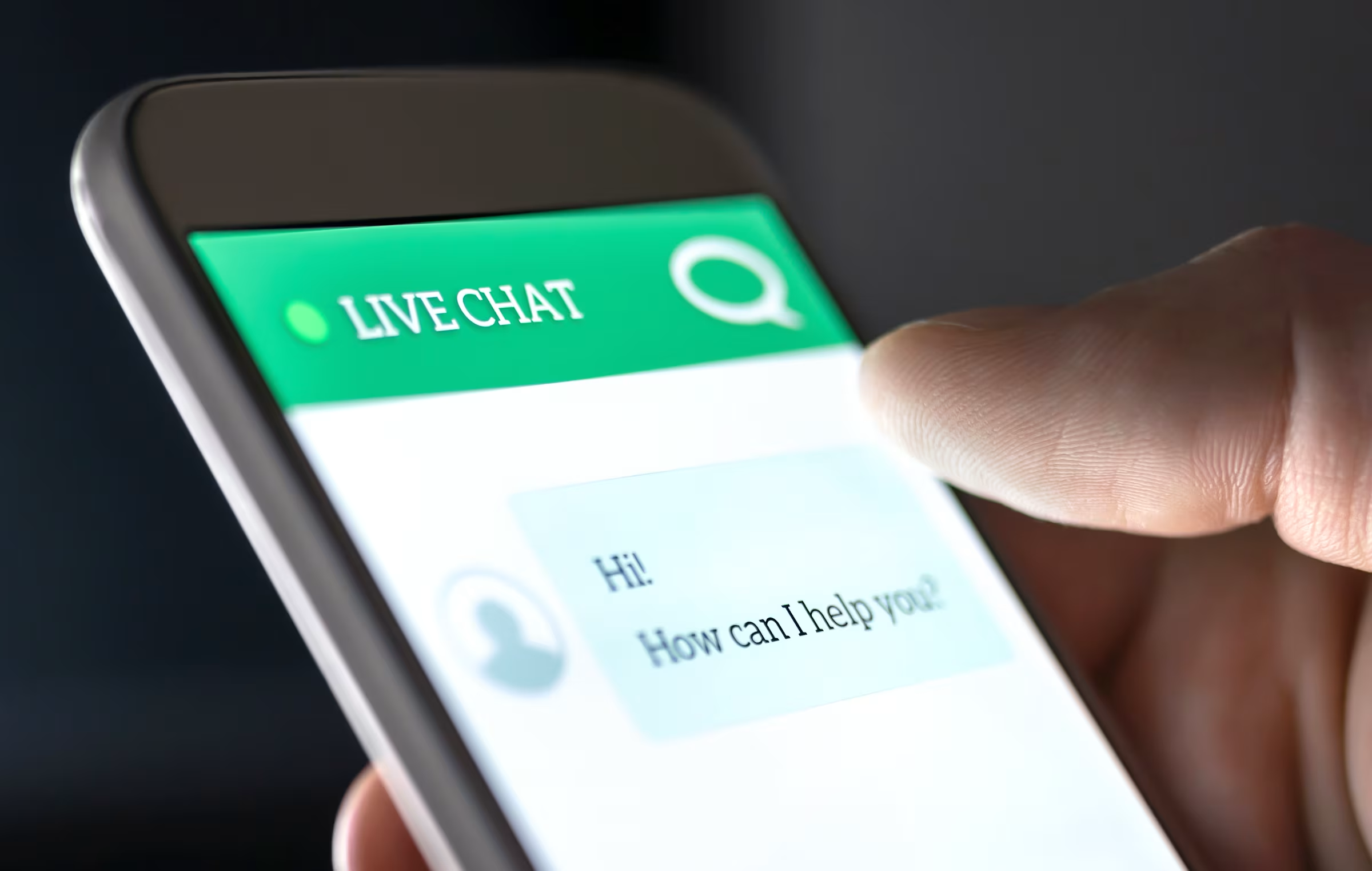
Credit: Tero Vesalainen / Shutterstock
As he instructs bilingual learners in the humanities and social studies, Daniel Gomez sees big promise in artificial intelligence.
“Teachers in general cannot be knowledgeable about every single subject,” and certainly not in multiple languages, says Gomez, who teaches at the bilingual K-12 Ideal School in Tampa, Florida. AI can help close the gaps. “It will be able to pick up any topic students are interested in and handle the topic reasonably well.”
He isn’t alone in this assessment. Harvard researchers, for example, are actively exploring how AI-powered chatbots can support bilingual student learning and parent–child dialogues.
“There are lots of opportunities to use AI to adapt learning materials into different languages, which can expand access for bilingual learners,” says Ying Xu, an assistant professor of education at Harvard and one of the researchers involved in the work.
“Some projects are also exploring how AI can provide additional scaffolding to help children comprehend content in their home language,” she adds. “For example, a multilingual language model might keep the core learning content in English while offering explanations, prompts or supports in the child’s home language.”
Experts see great potential for AI to elevate bilingual education — if it’s done right.
Chatbots as Educational Aids
“Bilingual learners are obviously learning the language and culture of the classroom and the environment that they’re in,” says Krystle Salas, assistant director of special populations at Second Mile, which operates alternative education charter schools for at-risk students in several states.
“They don’t necessarily have access to the instructional materials or even just the conversations going on in the classroom — and certainly not at the level of their peers,” she continues. And teachers may not have the experience or the tools to scaffold the necessary supports for these students.
AI can help teachers to be more effective, and it can help bilingual learners thrive. A chatbot “can give [students] pieces of the content in Spanish or give them smaller sentences that are simpler,” Salas says.
Chatbots can also help bilingual students build confidence. “Maybe I don’t want to talk in English in front of other people, but I’ll talk in English to the chatbot because the chatbot doesn’t care if I’m doing it wrong,” says Melissa Henning, the K-12 educational content manager at The Source for Learning.
“You can have a conversation with the chatbot about what you meant to say and what came out, and it can help you rephrase it,” she adds. “That can really empower you as a multilingual learner.”
Gomez sees a role for AI in helping young learners master the concepts being taught in the classroom. Perhaps the chatbot will teach it to them in their native language, but that’s alright. Students can get a handle on the materials, “and later on we can worry about knowing whether [they] also know the word” in English, he adds.
Chatbots can be a boon, too, because of their 24/7 availability. Although there are many ways to master learning materials, they don’t help “if you are not actively practicing,” Gomez says. Especially for those learning in a foreign language, AI’s ever-present availability creates more opportunities for practice.
Using SchoolAI, education strategist and ISTE Certified Educator Stephanie Howell has seen the benefits of AI firsthand. Students use it as a “guide on the side,” annotating as they read, she adds, “and if they don’t know a word, they can go over to the AI and say, ‘Explain this to me in another way.’ It creates that self-awareness skill. I’m not the one always finding the words that they need help with.”
As a second- and third-grade intervention specialist at Lancaster City Schools in Ohio, she’ll create a learning activity and tell the AI, “When they get it wrong the first time, I don’t want you to super-scaffold for them. I want them to have that productive struggle. But if they miss it a second time, I want you to provide a sentence starter.”
And she’s using AI herself to support her students. As a co-teacher, she’ll take what the main teacher has assigned and break it down, asking AI, “What vocabulary in this article might my students struggle with?” or “Help me analyze the patterns that you notice.” This gives her greater insight and more time in the day to focus on one-on-one learning and other high-value strategies.
Chatbots as Family Engagement Tools
Chatbots can also help close the gap for students who otherwise wouldn’t be able to talk fully about their schoolwork at home.
“A lot of parents speak Spanish. Their kids are coming home with this English stuff, and they don’t speak [the language]. Rather than having students speak in both languages, they can actually use both languages at the same time to build concepts,” with the chatbot translating simultaneously, Henning says.
“A lot of times the students are stronger English speakers than their parents,” she continues. With help from a chatbot, “they can engage in dialogue, positioning the home language as an asset rather than a barrier.”
Teachers can foster this. With their prompting, “a bot could send a family a nightly question tied to the day’s lesson, like ‘Ask your child about the bravest thing this character did in the book,’” she adds. “That gives non-English-speaking parents a way to have a conversation about that content.”
Best Practices for Using Chatbots
For schools looking to leverage chatbots in support of bilingual learners, experts say it’s important to move ahead thoughtfully. They need to be careful about “the unintended consequences of widening existing gaps,” Xu says.
“For example, many AI systems are still less accurate at recognizing bilingual children’s speech, especially when children have accented speech or dialectal variation or are moving between languages,” she adds.
As a result, “bilingual learners may benefit less from these tools if the system cannot accurately understand their speech,” she continues. “This concern also applies to the use of AI for assessment, where dialectal variation or accented speech could lead to inaccurate evaluation.”
Then there’s the digital divide to consider, since students will need access to the chatbots for any of this to work. “You want to make sure that we’re not widening the gap because they don’t have devices available at home or they don’t have internet at home,” Henning says.
Howell encourages teachers to make intelligent use of AI’s built-in multilingual capabilities. With some tools, “[students] can actually start typing in Spanish if I don’t set up the requirement to stay in English,” she adds.
That can be helpful, but it needs to used thoughtfully. “Sometimes as a teacher, I can’t have my students go back and forth because they have to learn it in English,” she continues. “It always goes back to the learning goal.”
Educators also need to be mindful about the AI models their chatbots are using. Tools may be trained on academic language, but students need to tackle school subjects informally as well. The AI should suit the need.
“If we need more technical vocabulary or something that is more prone to be used on an everyday basis, we can train it to do that,” Gomez says. “We can customize it to our needs.”
And the teacher’s voice should always be the most prominent. “Even though AI can be a very valuable tool — it can help with a great many things — you always need that human touch,” he adds.
At Second Mile, Salas echoes this notion. “Children need that human interaction,” she says. “A teacher can read their emotions; they can see the full context of the situation and adjust in real time. And AI can make mistakes, so we always want to make sure the majority of the instruction and support is coming from the humans.”
Popular on EdSurge
Read Next


News
Attendance
Child Protective Services Contact Linked to Higher Absenteeism, Study Finds
Voices of Change
Teaching and Learning


Voices of Change
Professional Development
Voices of Change
Artificial Intelligence
Protecting Student Cognition in the Age of AI
News
Tutoring