The Case Against the Classroom Cellphone Crackdown
Instead of banning the technology, schools have an opportunity to promote digital citizenship and student engagement.
By Dan Clark
August 19, 2026
Credit: PeopleImages / Shutterstock
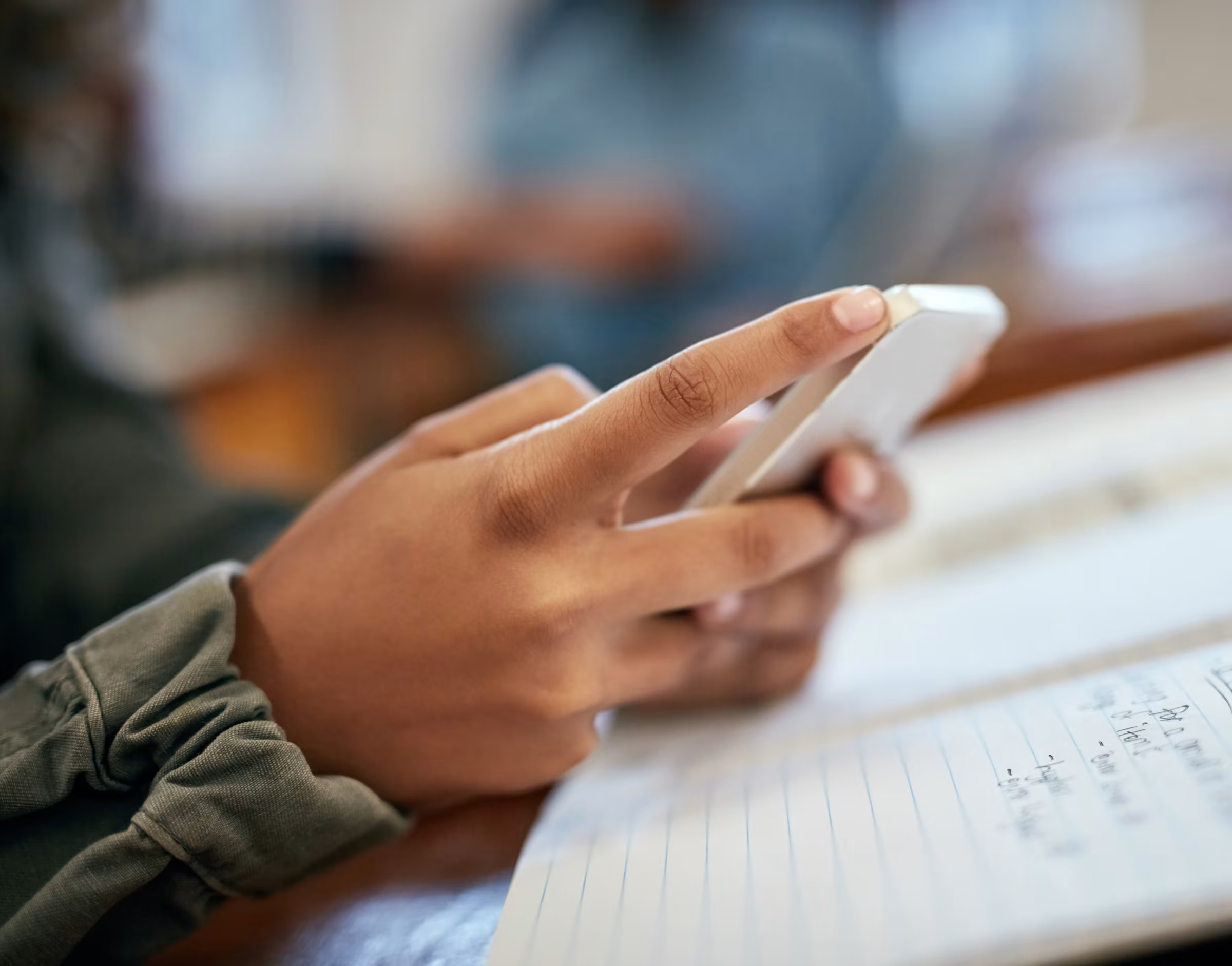
In 2025, my home state of Missouri passed a law, Senate Bill 68, that prohibits students from possessing any electronic communication device from the start of the school day until the end of the school day.
“It’s simple — cell phones have no place in Missouri classrooms,” Missouri Gov. Mike Kehoe posted on X, formerly Twitter.
It has become a concerning cycle in education: When any new technology becomes prevalent in our kids’ world — from TV to video games, and computers to the rise of AI — policymakers’ first instinct is to ban the technology rather than attempt to understand it.
A complete cellphone ban is a missed opportunity. Educators have heard and can easily understand many of the reasons a ban on cellphones makes sense in our classrooms. But as a middle school civics teacher in Missouri looking to engage students in real-life stories concerning media literacy, politics, and advocacy, the recent laws enacted to completely ban smartphones from school buildings are concerning. We may just be taking a tool away from our students instead of using it to help them connect with the broader world around them.
I believe there is room, and perhaps even benefits, in thinking more critically about how and when these new tools, including smartphones, could be used in the classroom to provide real and relatable learning opportunities.
Hanging on the Telephone
I first want to admit that my opinion here may be unpopular, especially among my fellow teachers. It is very easy to understand the reasoning behind the bans and crackdowns on phones in classrooms.
The first and most obvious reason is the potential for distraction phones provide. I will be the first to admit that I become distracted by an errant notification, a social media post, or even the same clip from a favorite TV show for the millionth time on my phone. Many of the apps on our phones are designed to hijack our attention, and children and teenagers are the most vulnerable to this.
Second, a phone is, by definition, a communication device. The rise of issues such as cyberbullying and inappropriate digital content makes using these devices more complicated in the classroom than, say, using a Chromebook or an iPad.
Growing up, as I did, in a time when the best cellphone could play the super-simple game Snake, I admit the sheer power and scope of what smartphones can do today is shocking. This is especially true for those writing technology policy. Our media also presents the theory that the proliferation of smartphones among young people has negatively affected mental health and attention spans.
However, one thing missing from many of these conclusions is the idea that it is not the tool itself, but the content consumed, that has an impact. What if we took the time to show students how this tool could be used to build positive connections, create new and exciting ways to express themselves, and connect with information in ways never seen before? This past year, I got to experience how the absence of this technology could affect the authenticity of learning.
Living in the Real World
Like every Missouri school after the new cellphone ban law passed, my school immediately clamped down on phones in the building. We already had our own general school rule about no phones, but this year, the consequences and enforcement were more intense and closely monitored.
We told the students, “Sorry, it’s against the law now,” and went on with our lives. However, at the beginning of this past year, I began teaching a new, yearlong program called Youth 2 Lead. In this program, my eighth-grade students were tasked with identifying and selecting a problem in their community; conducting outreach to community members, citizens, elected officials, and policymakers; and ultimately taking action to address the issue.
When I asked students how they thought they could best reach people and make their voices heard, they invariably said the best way was through social media platforms like TikTok and Instagram.
Here is where I first felt that the full-on phone ban in my state maybe wasn’t as simple as I first believed. I now had to teach students to “be authentic, use your voice and your resources to make a change in your community,” while simultaneously telling them, “don’t use the tool you are most comfortable with — which would likely be the most powerful tool in your arsenal.”
As our project progressed, we identified an issue and wanted to survey our community. Again, I asked, “How do we collect the opinions of those in our community we don’t know?”
We came up with two options: create a social media account, or create a survey and either spread it online or use public data to mail postcards and wait for replies. We went with option No. 2 — not because we thought it was the best, but because the limitations of our classroom technology made the first choice impossible. Again, we were forced to concede authenticity in our learning for policy.
Finally, toward the end of our project, after working all year to develop a plan, two very determined students said, “Mr. Clark, none of this matters if no one knows we are doing it. We have to have a social media presence.” I shared their concern.
Yes, we could put it on our school’s Facebook page and newsletter, but that is only seen by our own small community. These kids had worked hard, and they wanted everyone to see their passion and results. So I said, “Well, what if I make my own Instagram account, you tell me what you want on it, and I will upload things in my free time?” They were deflated.
Sure, that would work — and is what we ended up doing — but they wanted to own it, wanted to make it work, and had a much better sense of how to do it than I ever would.
Because of a policy made by non-educators in government, my students and I were not able to have the flexibility and tools to show off our best creativity. Why can’t I, as a teacher, choose when and how technology is used in my classroom, especially if I believe it will enhance learning?
Doom or Destiny
So if I am arguing that a phone ban is not the best solution, what should be done? There are many other ideas that could be implemented to provide both students and teachers with flexibility and to refute the one-size-fits-all solution of a statewide ban.
We have seen companies such as Yondr step in to create products that students can use to store their phones when not needed. These protective pouches can be unlocked by the teacher when needed and locked again at other times, helping eliminate distractions.
Schools can implement turn-in systems where students turn in their phones at the start of class and retrieve them after. Most importantly, in my opinion, schools can and should take a more active role in teaching digital citizenship and literacy — not just from an academic standpoint, but as a key learning standard for kids growing up in a digital world.
Many people argue that we should go back to teaching cursive to all students. I’d argue that our kids will be using smartphones a million times more often than writing in cursive.
Like it or not, our students are part of a technological system more advanced and connected than we would have dreamed of at their age. The very device we are so afraid of is also the one they will most likely do a vast amount of their future work on.
Yet, we are telling them in school that it has no value. However, when our students have the freedom and trust to engage with the world and especially technology authentically, we can be a part of showing them how to use these tools for good. For instance, our Youth 2 Lead campaign eventually led to interactions with our city council member, who interviewed our students for social media.
Do phones cause distraction? Yes, absolutely. But I’ve also had to tell many students to stop reading during class because it distracted them from learning, and I’m not banning books anytime soon. Kids are kids; they will find a way to distract themselves no matter what.
I think the bigger issue is our fear of a changing world getting in the way of our duty to help guide our students into that world. We can use digital citizenship lessons, technology classes, and creative behavior management to uplift and encourage students to use technology appropriately. If we constantly downplay the importance of the powerful technological tools that are central to their experience, we aren’t helping — we are becoming a distraction.
Popular on EdSurge
Read Next

News
EdSurge Podcast
Two Students, Two Questions They Wouldn’t Let Go

Voices of Change
Artificial Intelligence