The K-12 Silo Won’t Survive AI — But Our Relationships Might
I left my school to ask tech executives how to prepare students for the future.
By Beth Yirga
August 12, 2026
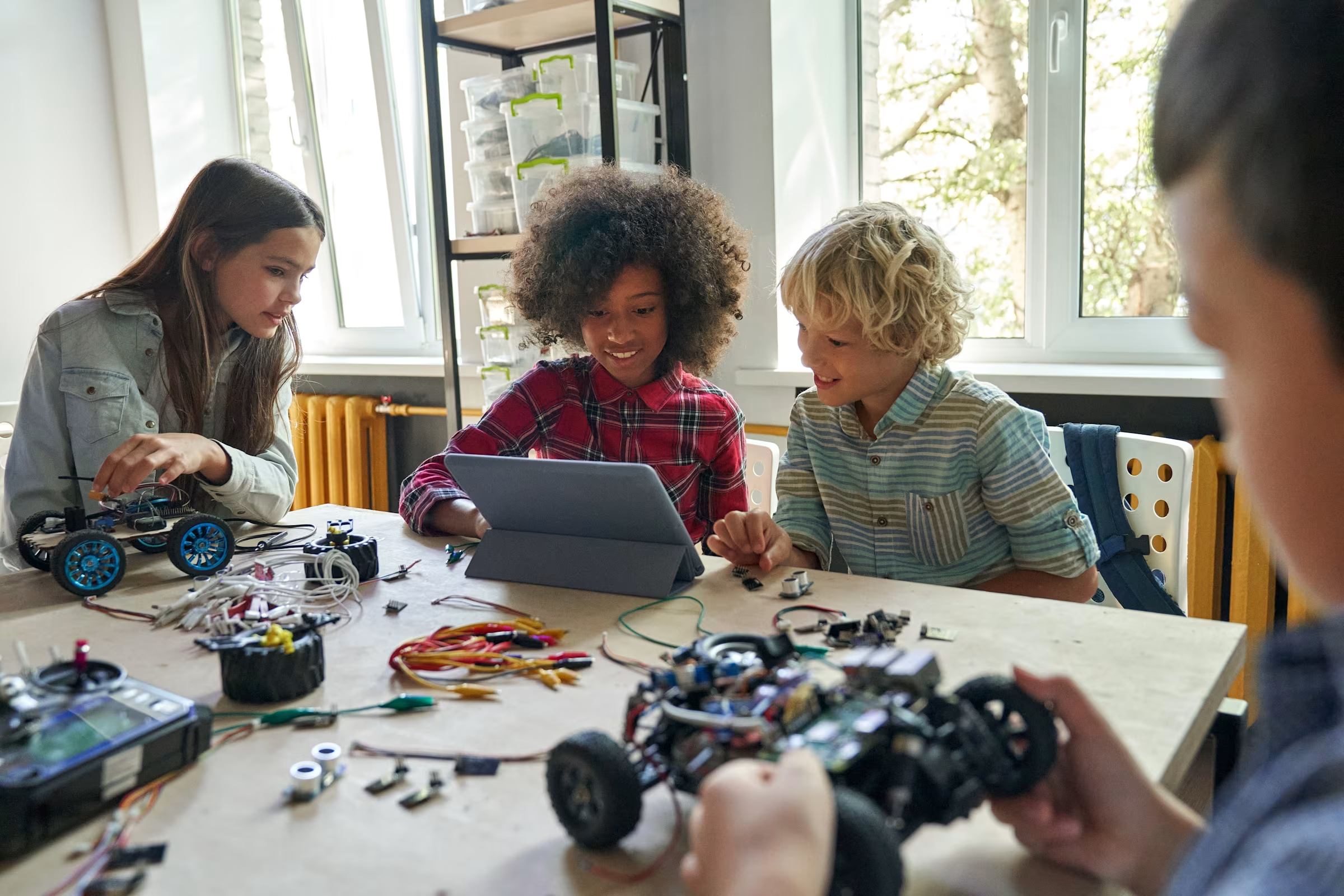
Credit: Ground Picture / Shutterstock
Have you ever been in a room where the energy was palpable, only to have the air leave the room in an instant? I found myself in that type of room this year, right when AI entered a conversation about designing a program focused on career exploration and social-emotional learning.
Last August, our community was happy to learn that we won the Delaware Pathways Middle Grades Grant (DPMG) for $150,000. Our team’s objective was clear: to create an equity-centered bridge between middle school and high school that would guide our students to explore careers, ground themselves in a sense of belonging, and develop the academic and social-emotional skills they will need to envision their future. Yet the mission before us was vastly different for this generation of students, as AI drastically changes modern industries and workforces in real time.
Over the next two months, my task was to lead the charge in gathering teachers, students, family members, administrators, board members and community partners. We knew that if we were to succeed, we had to be guided by the spirit of our school, even in the face of uncertainty.
The Question That Changed Everything
It was a rainy October morning when we convened at Freire Charter School, an inclusive social justice school based in Wilmington, Delaware, that serves students in grades 8 through 12 and is named after Paulo Freire, the Brazilian education philosopher.
Freire’s belief that education is a choice between maintaining conformity or acting as “the practice of freedom” guides our school’s core value that people, especially students, can critically transform their world. But first, we had to figure out how to do that in the face of such rapid technological change.
I was sitting at the long table in our conference room alongside a diverse team of lifelong learners, ranging from Generation Z to Baby Boomers and everyone in between. We all held unique vantage points — from former superintendent to eighth-grade class president to mompreneur — that were valuable to the discussion. Yet our lively conversation came to a halt when a student asked, “If AI will do everything, then what’s the point of learning for us?”
The room instantly went silent, and that silence became our catalyst for change.
Looking Beyond the Silo
The consensus following our first meeting in October was that we had to learn for ourselves what various industries were facing from the rise of AI, and that if we stayed inside the traditional K-12 education silo, we would never find the answers we needed. So, I left the building — not physically forever, but intellectually and professionally — to seek conversations with people working in sectors already grappling with AI’s impact through technology, higher education, science, workforce development and entrepreneurship.
That journey led me to the Women Who Code Summit in New York. Surrounded by hundreds of women and gender-diverse professionals working at the forefront of technological innovation, I was the only educator in all of the conversations I entered.
Standing in a room filled with software engineers, executives and founders, I asked a simple question: “What should schools be doing right now to prepare students for an AI-centered future?” The responses surprised me.
Technology executives, engineers and innovators shared the same concerns educators were voicing back in Wilmington. They worried about workforce shifts, ethical implications and what it means to be human in an increasingly automated world. Most importantly, they wanted to help.
The reality is that the challenges facing today’s students are too complex for any single sector to solve independently. This reality is especially true for students from historically under-resourced communities.
Examining Access to Relationships
Research consistently shows that access to social capital, mentorship networks, and career exposure plays a significant role in educational and economic outcomes. A study in the Journal of Youth & Adolescence cited that “strong relationships are critical for emerging adults’ postsecondary success, and that strong workforce and education support programs that provide access to this type of social capital are one avenue for facilitating success.”
Yet these opportunities are often distributed inequitably. Students from economically developed communities frequently benefit from professional networks and career-connected learning experiences that are unavailable to many low-income students, students of color and first-generation college-bound students. Under the eligibility criteria for federal programs such as Title I, Title IV, and Title V, more than 47% of our student body is classified as economically disadvantaged.
As a first-generation college graduate raised in America by working-class Ethiopian immigrants, I experienced the educational inequities my students currently face in a pre-AI world. In either era, when educational inequity is discussed, the focus is often on curriculum, assessment and funding. Those conversations matter; however, we must also examine access to relationships.
Who gets exposure to professionals? Who sees themselves reflected in future careers? Who has opportunities to imagine possibilities beyond what they currently know? These questions are at the heart of the work we are building through Freire Wilmington’s eighth-grade academy.
Designing for Human Connection
As a DPMG grant recipient, our program must align with Delaware’s Middle Grades Career and Technical Education exploration standards, which build upon essential human skills: empathy, belonging, identity development, culturally responsive instruction and career exploration. We asked students what it looks like for us to practice being human every day, and they shared: being outside more, connecting with nature, using their hands to create, helping others in real time and teaching each other.
As a planning team, we began to envision school days with daily outdoor hikes and morning meetings, incorporating Teen CERT (Community Emergency Response Team) certifications, visiting various high schools and colleges, attending an opera, heading down to Legislative Hall at the Delaware State Capitol and more. The goal is not simply to prepare students for jobs. It is to help students develop healthy self-images, meaningful community connections and confidence in their ability to navigate future opportunities.
Our students, alongside our educators, parents, board members and school administrators, are creating opportunities to explore who they are becoming before they are asked to make critical decisions about high school pathways and postsecondary plans in an AI-driven world.
Preparing students for this AI-driven future is not primarily about teaching them to use tools. It’s about incorporating AI into our everyday lives while strengthening the human capacities that technology will never be able to replace:
Curiosity.
Collaboration.
Critical thinking.
Ethical decision-making.
Empathy.
Adaptability.
Community-building.
These are the durable skills that will matter regardless of how technology evolves.
Radical Possibility in the Classroom
Black feminist traditions have long taught that collective liberation depends on community, imagination and shared responsibility. This is not abstract theory; rather, it is a practice rooted in how people survive, resist and build futures together.
As Charlene Carruthers argues in “Unapologetic,” movements for liberation are sustained through disciplined collective care and the ongoing work of building relationships grounded in shared struggle and mutual responsibility. Author bell hooks extends this idea into educational spaces, reminding us that “the classroom remains the most radical space of possibility in the academy,” where learning can become a practice of freedom rather than compliance.
Both authors inform us that survival and progress emerge through connection, not isolation. The educational challenge before us is not simply how to teach students about AI. It is how to build ecosystems of support that help young people navigate uncertainty with confidence.
I am guiding our eighth-grade academy team to build stronger partnerships with employers, higher education institutions, community organizations and emerging industries so they show up in our classrooms to create pathways for connection. We need students engaged in authentic conversations, grappling with current problems and using their voices to contribute to the changes occurring in rapidly shifting fields. From CEOs to electricians to realtors to welders, our students will be able to ask real questions of the current workforce navigating this AI shift, and problem-solve alongside them.
Navigating Uncertainty Together
As we wrap up this summer learning from leaders in technology, science, higher education and workforce development, I am reminded that uncertainty does not have to produce fear. In our community, uncertainty inspired collaboration.
The future our students will inherit is still being written. Our responsibility is not to predict every technological change ahead, but to ensure that every young person — especially those historically excluded from opportunity — has the relationships, confidence, skills and sense of belonging necessary to shape that future themselves.
Whatever the future holds, our students and this work remind us that the most important technology in the classroom isn’t AI; it’s the human connection we build to navigate these uncertain times.
This story is part of an EdSurge series chronicling educator experiences. These stories are made publicly available with support from Learning Commons. EdSurge maintains editorial control over all content. (Read our ethics statement here.) This work is licensed under a CC BY-NC-ND 4.0.
Popular on EdSurge
News
Hundreds of Thousands of Eligible Kids Are Waiting for Childcare Assistance
Moriah Balingit and Lauren CoffeyNews