The Library That Sparked a STEM Revolution for Our Students
To truly close the digital equity gap, educators must become architects of student possibility.
By Tambra Clark
August 5, 2026
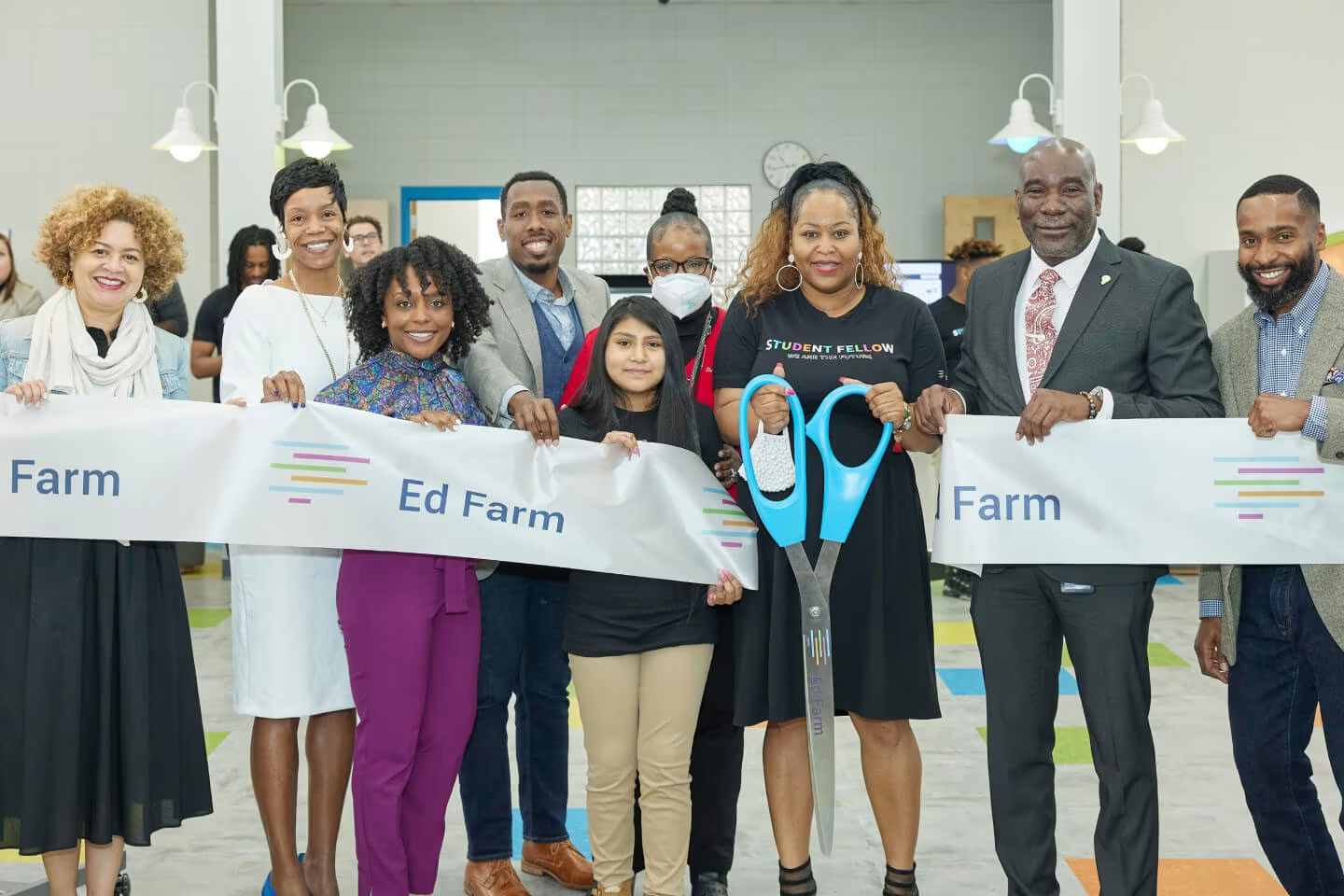
Credit: Ed Farm
For years, as a library media specialist, I took great pride in my role as guardian of the 20,000 books in our library, meticulously cataloging and protecting our collection. But after dedicating nearly two decades to education, I came to a vital realization: The most important chapters in our school’s history weren’t on our bookshelves; they were waiting to be written by the students themselves.
I’ve seen firsthand how easily innovation can get reduced to a one-time event: a quick photo-op, a splashy press release, or the arrival of a new shipment of shiny devices. It’s frustrating because that approach never lasts; it’s a temporary buzz that leaves the core of our instructional ecosystem fundamentally unchanged. The real problem is that our students deserve more than a “device drop.” They need and deserve a long-term commitment that actually reshapes how they learn.
That shift in perspective is what drives my work today. I’ve moved from being a gatekeeper of static resources to someone who actively creates a dynamic, student-centered environment. It is no longer just about having resources; it’s about ensuring they become the backbone of a sustainable, future-ready classroom experience.
The Quiet Before the Storm
For the first 10 years of my career, my roles ranged from teaching third and fifth graders to serving as a school technology teacher and a sixth-grade pre-AP reading and math instructor. Following 10 years across multiple grade levels and content areas, I transitioned into the role of a library media specialist, which soon became my entire world. My days were defined by the ebb and flow of students coming in to check out books and learn the literacy skills necessary to develop knowledge.
Parents, community members, and even fellow educators often referred to me as “just a librarian,” and while I wore that title with pride, I was acutely aware of the silent burden we carried. The library was viewed as a traditional hub for books and nothing else, leaving our students tethered to the past while the world raced forward in technology and innovation. Our students possessed inherent brilliance, yet they were consistently overlooked by a STEM narrative that rarely considered our zip code.
Society often operates on an unspoken assumption that technological breakthroughs belong exclusively to affluent districts or established tech hubs. Because our community didn't fit that traditional mold, the narrative bypassed us, systematically starving our students of the advanced tools and platforms required to translate their raw potential into tangible innovation.
Everything changed for us when I had a conversation with Beth Sanders, then vice president of Ed Farm. The nonprofit organization, headquartered right here in Birmingham, launched a strategic partnership with Birmingham City Schools (BCS). Their goal was clear: to boost educational equity by closing digital skills gaps across our district and region. While the strategic partnership between Ed Farm and BCS had already been established since 2020, I learned that my space, the South Hampton K-8 library, had recently been chosen for a complete renovation.
Beth Sanders approached me with this incredible opportunity, knowing that this project would be the first of its kind in the state of Alabama. Our discussion became the catalyst for completely reimagining the space. In addition to the physical Ed Farm spaces, educators and students benefited from specialized fellowships. Together, these initiatives pushed us beyond the status quo, ensuring we prioritized sustainable, future-ready learning over superficial technology adoption.
Students were also invited into the design process, and for the most part, they led the way. I sat back and watched as they traded ideas about robotics, green screens, and iPads. Witnessing them design their own future before a single wire was plugged in proved we were creating something much bigger than a state-of-the-art library — we were creating the library of innovation.
Becoming an Architect of Possibility
In 2022, we finally cut the ribbon on the first official Ed Farm space at South Hampton K-8 School, “The Library of Innovation.” Balloons were tethered to the doorways, camera crews maneuvered for the perfect angle, and city officials were buzzing with the promise of a new era. It was one of those “pinch-me” moments, seeing the last couple of years of dreaming and planning finally take physical shape for our kids. But when the local city council members, edtech partners, and school board officials headed home, the real, gritty, unglamorous labor of building capacity began. My mission shifted from being a keeper of books to an architect of possibility.
By moving past traditional keyboarding to teach coding, website architecture, and engineering principles, I equipped students to interrogate their environment and engineer solutions to the challenges they encounter in their own neighborhoods. Instead of just learning how to use software, they began leveraging creative programming workflows to design AI and Internet of Things-driven systems, such as functional tornado warning models, to address severe weather threats right here at home. Seeing them build these concepts proved that this space was doing exactly what it was meant to do: transforming students from passive digital consumers into true architects of possibility.
Over the course of the next year, the library had transformed into a dynamic laboratory. The hum of 3D printers bringing custom keychains and game remote holders to life became our soundtrack. The sharp whir of drone propellers slicing through the air replaced the static silence of the past. The intense, focused chatter of a student-led podcast recording of “Bulldog Talk on the Edge” became the new student voice. We purposefully curated this environment to break the traditional mold, challenging the students to completely redefine their expectations of the space and of themselves.
Defying the Narrative: From Participation to Mastery
In an urban environment, the STEM narrative is often restricted and expectations are frequently capped. This cap does not exist because of a lack of student capability but rather because of a systemic failure in how society views innovation. The narrative feels capped because the broader educational system frequently assumes urban students only need to learn how to participate in the digital world as consumers, rather than being equipped with the sophisticated coding environments and engineering principles required to master it as creators.
From the first day the library reopened, I watched the confidence of our students bloom. As they mastered the new tools, this newfound confidence translated into tangible success, resulting in a series of competition wins and vital funding for our school. They took that confidence and applied it to real-world problems.
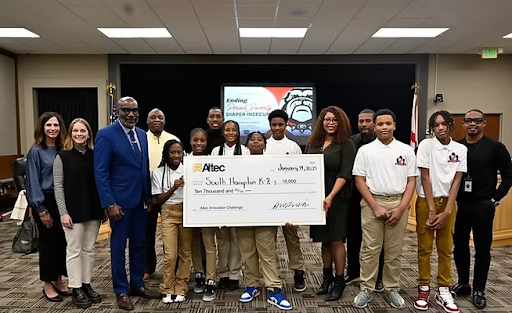
During the 2024-2025 school year, they won the ALTEC Challenge for the “Hygiene Hub,” a vending machine solution for personal care products paired with a custom community app they coded.
Next, we won $12,000 in Samsung technology representing the state of Alabama in the Samsung Solve for Tomorrow competition with an upcycling machine designed to turn old clothes into hygiene products.
The momentum continued when three of our seventh-grade students won the Alabama state title in the eCYBERMISSION competition, earning $500 in savings bonds each for their innovation. This all happened in the span of one school year, cementing the fact that our students weren't just playing with STEM. They had become experts in their domain.
However, the ultimate validation of our shift came this past school year. In April, our students rose to become national finalists in Samsung Solve for Tomorrow, standing out as one of only 10 schools in the entire nation. They secured $50,000 in Samsung technology. The experience offered so much more: My students flew to Washington, D.C., and stayed on Capitol Hill to pitch an early-warning system for tornadoes they created for The Washington Post. Their presence on that stage, pitching for the $100,000 grand prize, was proof that their innovation belonged in the highest arenas of influence.
Redefining Excellence
How does a library, once defined by shelves of paper, become an incubator for national-stage innovation? It happens when you stop viewing technology as a product and start viewing it as a catalyst for human agency.
The gap between buying tech and building capacity is bridged by leadership that refuses to let the innovation end when the ribbon is cut. It is bridged by mentors who show students that their zip code does not dictate their capacity to lead. When you provide students with the right tools, these students don’t just keep up; they excel.
In the span of one year, my students transformed what it means to be a student in Birmingham City Schools. We proved that when students in urban, underserved neighborhoods are given the resources to match their ingenuity, the results are world-changing.
This library is no longer just a place to check out books; it is where students can rewrite their own narratives. The ribbons may be gone, but the ecosystem we built remains a living, breathing playground of innovation. We didn’t just join the STEM conversation; we changed it.
This story is part of an EdSurge series chronicling educator experiences. These stories are made publicly available with support from Learning Commons. EdSurge maintains editorial control over all content. (Read our ethics statement here.) This work is licensed under a CC BY-NC-ND 4.0.
Popular on EdSurge
Read Next

Voices of Change
Artificial Intelligence
Why AI Made Me a Better Principal
Voices of Change
Artificial Intelligence
News
EdSurge Podcast
Two Students, Two Questions They Wouldn’t Let Go
Voices of Change
Artificial Intelligence

Voices of Change
Artificial Intelligence