Early Childhood Education Teachers Grapple with Screen Time
The AAP’s new guidance helps, but putting it into practice in classrooms remains challenging.
By Adam Stone
July 24, 2026
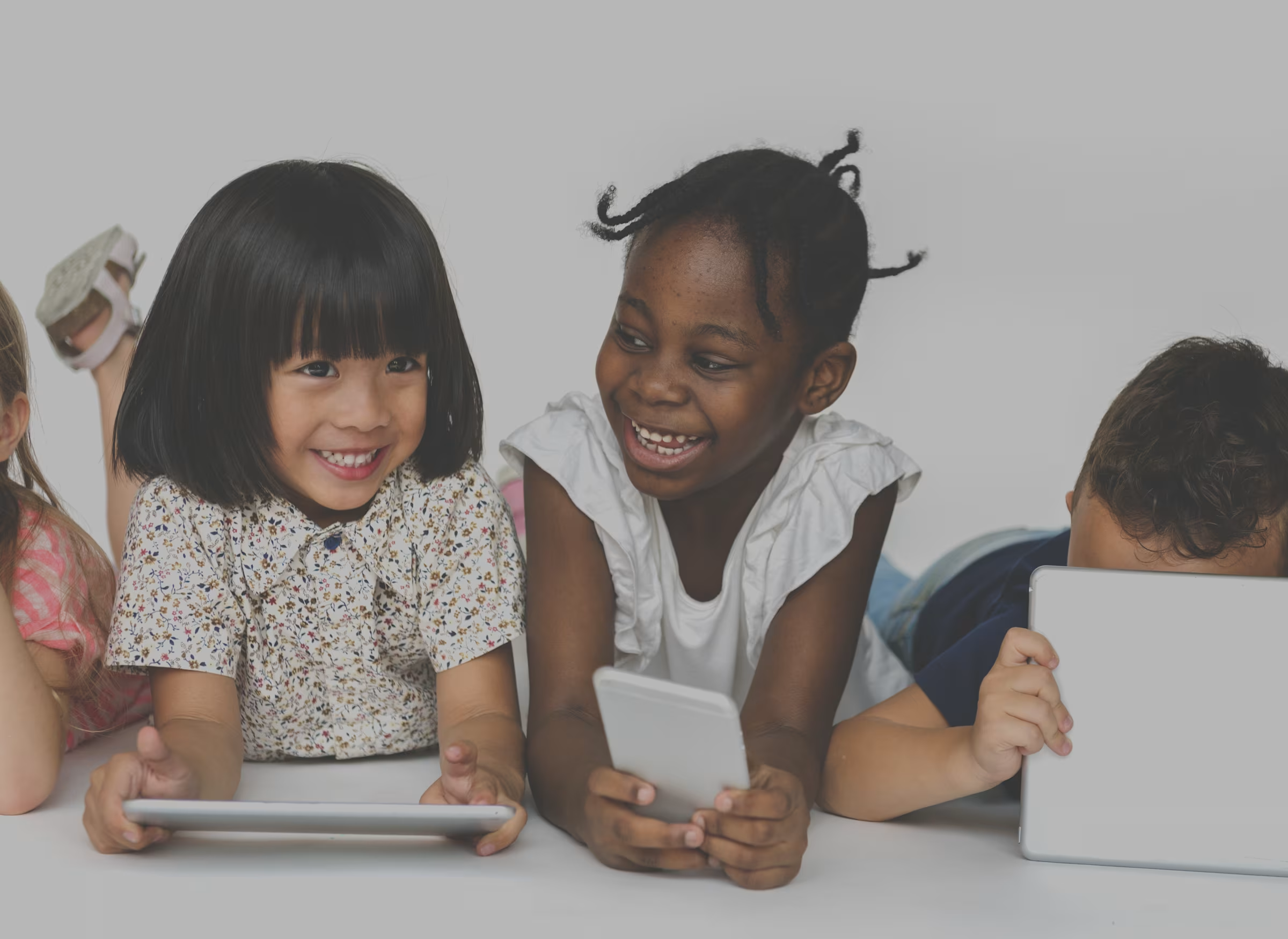
Credit: Rawpixel.com / Shutterstock
When the American Academy of Pediatrics updated its guidelines around screen time for children and teenagers for the first time in 10 years this past January, many teachers and educators applauded the news. The document focused less on television and more on digital devices. It offered educators, families, pediatricians, and other stakeholders research-backed guidance on using digital devices to support children’s learning, rather than prioritize prolonged engagement.
However, many of the recommendations were not tailored to specific age groups. Recommendations like “create a family media plan” and “protect sleep” were helpful but offered few concrete steps for pre-K students.
That left early childhood educators asking what they could do for their young learners.
The Risks in Pre-K Through K
Unlike the physical world, digital content comes fast, in short bursts, and when kids get used to that, it has negative consequences. “Too much of this screen and things jumping in front of them, it could be damaging overall,” says Latoya Jones, a pre-K through fifth-grade media specialist in Broward County, Florida. “They are developing their cognitive processes, and if we’re teaching them to think in six-second bursts, maybe that’s not what we’re aiming for.”
When kids interact with devices rather than people, their emotional regulation can suffer, says Kristina Turner, a first-grade teacher at the Paterson, New Jersey, campus of College Achieve Public Schools, a network of three K-12 charter schools. “A lot of the students, they are quick-tempered because they’re just used to quick things. If something takes too long, their behavior starts to heighten,” she says.
For the youngest learners in particular, “it is so important that they are learning how to interact, and listen, and even advocate for themselves,” says Colleen Francisco, a kindergarten teacher at Laurel Springs School.
“There’s beauty in students having an issue or a problem, because then an adult can support them in working through it,” she says. When kids are tethered to their screens, those opportunities don’t arise.
Clearly, the AAP guidance is well timed and much needed. But how to put that guidance into practice?
Classroom Strategies for Reducing Screen Time
“I never want my children using screens passively,” says Devon Caldwell, a pre-K and K teacher at Canupawakpa Education in Manitoba, Canada, instructor at Nipissing University Schulich School of Education in Ontario, and SMART Technologies & Lumio Ambassador. “I want to see kids’ bodies moving, their mouths talking, little hands making something.”
To that end, she prioritizes co-viewing and co-creating, using interactive teaching software approved by her and the school. When students are using a screen, “they’re always using it with a partner. Right away they’re negotiating rules, talking to each other, developing those really important skills,” she says.
For her first graders, Turner tries as much as possible to create hands-on activities instead of relying on screens. For example, she uses a whiteboard, but tries to avoid it when giving instructions. “Students have to use their listening skills so they can be able to follow directions without using a screen,” she says. “By end of school year, I’m able to give them different tasks, and they’re able to do that independently, without depending on technology.”
Tyler Brown, an English teacher at Indian River Middle School in Philadelphia, New York who spoke recently at a GoGuardian webinar on screen time in school, encourages teachers to be thoughtful about the digital tools they share with the youngest learners. “Don’t throw [the digital tool] at everything,” he says. “Think about what you’re using it for. Think about what it’s supposed to do. Is this an enhancement of learning or is this a replacement?”
These self-directed questions can drive practical choices in the classroom. “You’re doing AT words: cat, mat, bat. You could easily have a website or a Google slide where they’re dragging those items onto the correct word,” says Brown.
“Or you could do what we’ve done in the past, which is a cut-and-glue activity,” he continues. “Why are we using screen time for something that can easily be a manipulative activity, where kids are doing things hands-on? Little kids are tactile learners, and those hands-on exercises have real value.”
Even as a teacher in an online school, Francisco is finding ways to limit screen time. “One of our assignments is taking a nature walk and writing down what you see. That is something that extends the learning off the screen,” she says.
Even math can be hands-on for early learners, she adds. “You don’t have to have anything fancy. You don’t have to buy the tools: Even just using cereal in order to practice adding and subtracting,” she says.
Jones was a kindergarten teacher before becoming a media specialist. “Anytime I had a word of the week, we used Play-Doh to build a word. Or we did those little sandboxes where they drew the word in the sand,” she says.
Big picture: Active and tactile often are better than passive and screen-based. “Could this be accomplished with blocks or Play-Doh or markers and paper? If it could be, let’s do it that way,” Caldwell says.
But teachers can only do so much in the classroom when kids are immersed in digital media at home. In support of the AAP’s call to prioritize family time over screen time, teachers may need to engage more with parents.
Engaging with Families
Pre-K and K teachers don’t have control over what kids do outside of school. “At home, a lot of my students go straight to their screens,” Turner says. To help steer her own kids and her students when they are at home, she gives parents resources. “I’m able to provide them with index cards, and you can keep them in the back seat,” she says.
When kids get in the car, “instead of reaching for an iPad, they can reach for their index cards, whether it’s math problems or sight words,” she says. “Or you can put that as a magnet on your refrigerator: If you want a snack, you got to read this word.”
When Francisco sends homework through the learning management system, “we have workbooks and other hands-on activities that support the lesson,” she says. And she encourages parents to talk to their kids, as a pedagogic exercise.
“Phonemic awareness is especially important to early-literacy learners. The learner is listening to sounds and how sounds are manipulated,” she says. “I’ve given parents additional resources so that [kids] are not reading or not listening or watching on the video. Instead, they’re doing it with their student, face to face.”
It takes some creativity and extra effort by teachers and parents to pivot kids off of screens, but experts say it’s worth the effort. Too much screen time “can negatively impact executive functioning, socio-emotional and language skills,” says Bryana Casas M.A., master teacher at Pacific Oaks Children’s School in Pasadena, California.
For those honing their interpersonal skills — a main goal in pre-K through K education — “nothing can replace relationships and face-to-face interactions between people,” she says.
Popular on EdSurge
Read Next


Voices of Change
Coding
How Coding Can Cultivate Deep Civic Engagement

On AI Policy, Students Have Plenty to Say

News
EdSurge Podcast
Can Schools Trust AI Features in Edtech Products?

Voices of Change
Artificial Intelligence
Stitching the Future: Technology as a Sacred Trust

News
Higher Education
